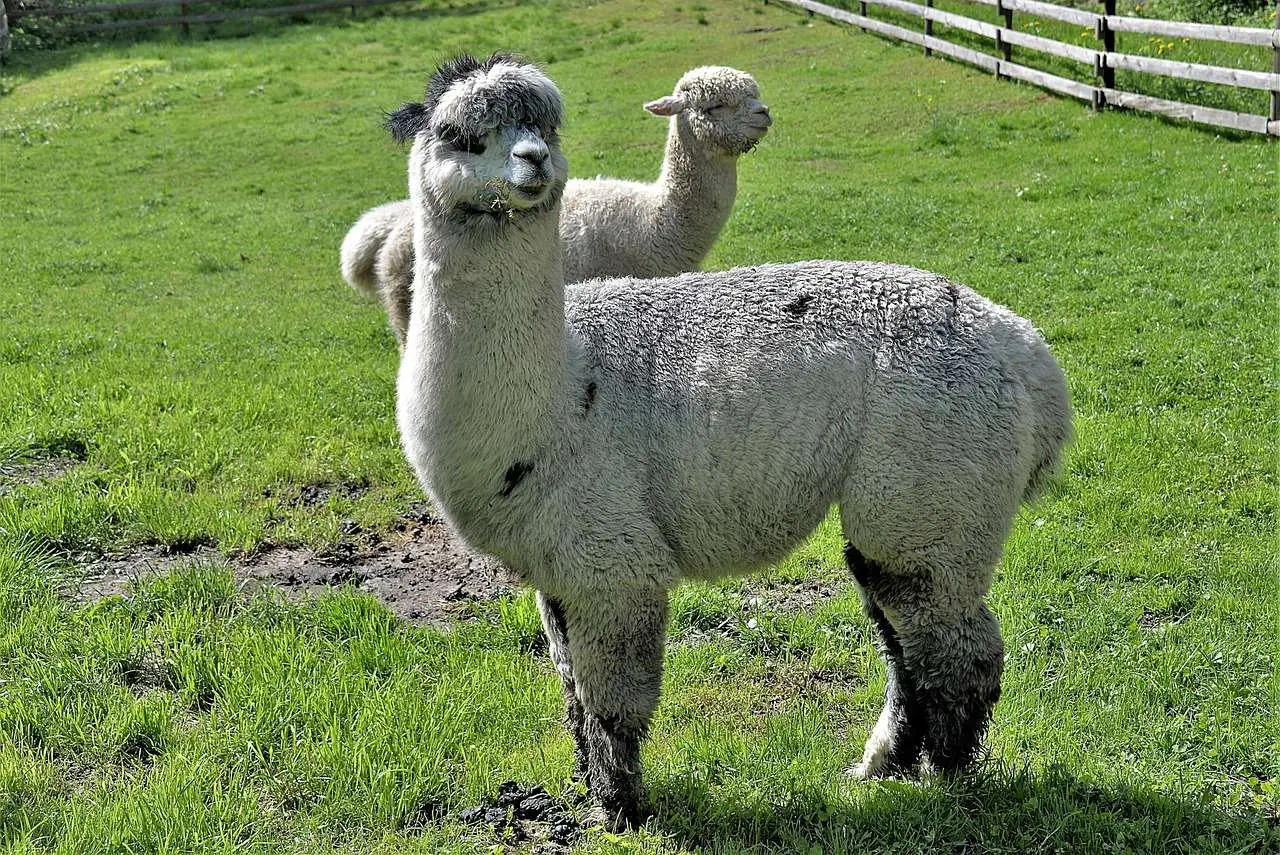

Watching a newborn and wondering what’s normal? Baby alpaca cria care comes down to a calm birth, a cria standing early, colostrum in the first hours and daily weighing. Call a camelid vet if anything seems off.
This guide is one part of the wider alpaca care section, which covers day-to-day husbandry.
| Item | Value |
|---|---|
| Normal alpaca birth weight | 7-11 kg |
| Time for a newborn camelid to stand | 15 to 45 minutes |
| Colostrum target | 10%-15% of body weight within 24 hours, ideally by 12 hours |
| Alpaca weight gain after the first 24 hours | 100-250 g/day |
| Birth weight roughly doubled | By 1 month of age |
These figures come from the MSD Veterinary Manual. Guidance can change, so check the source before you rely on them. This page is general information, not veterinary advice.
Preparing for the birth
The early weeks carry the highest risk of a cria’s life. A UK epidemiologic study, summarised in a veterinary chapter on lactation and neonatal care, reported that 17% to 33% of deaths in alpacas occur during the first 6 months of life. Most neonatal deaths are linked to events around birth, such as dystocia, poor mothering ability or exposure.
Care of the newborn starts during pregnancy. The same chapter notes that more than 80% of fetal growth occurs in the last trimester, so the dam’s nutrition, vaccination and herd health all matter. The alpaca gestation period guide explains how long pregnancy runs, which helps you know when to begin close observation.
The same chapter suggests these preparations:
- Watch the dam frequently in the last week of pregnancy, since that is how you judge when birth is approaching.
- Place close-up females in a clean grassy paddock, or a clean barn that allows easy observation.
- Avoid moving the female or changing her social group during the first stage of labor.
- Agree a clear emergency protocol and communication channel with your attending veterinarian beforehand.
- Keep the placenta refrigerated, in case your vet wants to examine it.
Getting through this stretch is what lets a cria go on to the full alpaca lifespan, which has its own guide.
The first hours after birth
Newborn camelids stand within 15 to 45 minutes and begin bonding with the dam straight away, according to the MSD Veterinary Manual. If everything is progressing normally, the pair should be left undisturbed to bond.
The MSD manual also expects crias on their feet within 30 minutes and attempting to nurse within 30 minutes to 1 hour after birth. A University of Tennessee proceedings paper is more relaxed, saying crias normally stand by 1 hour and nurse by 2-4 hours. Sources differ, so ask your vet what to expect on your farm.
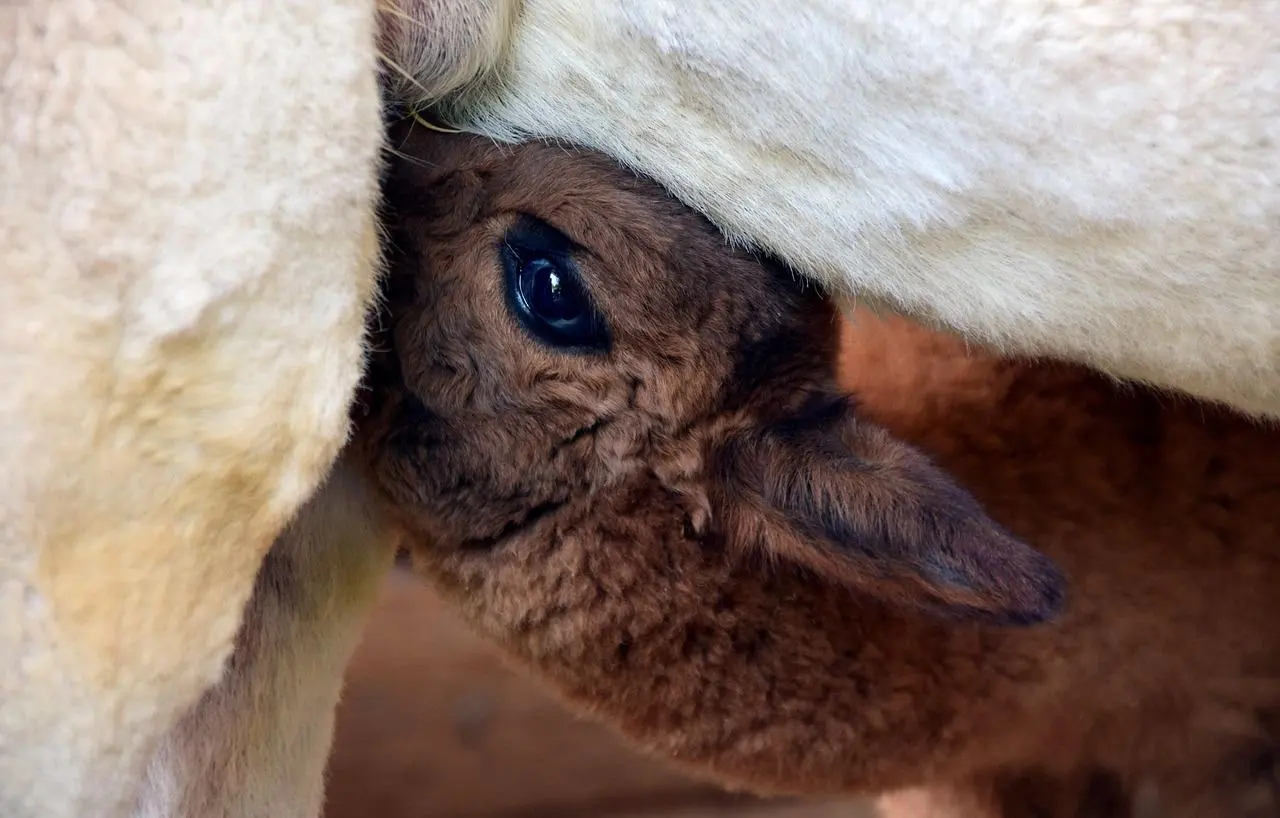
Keep your own role small and watchful. The neonatal care chapter advises limiting human intervention so the dam-cria bond is not disturbed, while still monitoring the cria from a distance. A few routine tasks still apply:
- Check the newborn within the first few hours for developmental abnormalities or trouble adjusting to life outside the womb.
- Remove any remaining epidermal membrane with clean towels, as the chapter describes.
- Weigh the cria and dip the navel in dilute chlorhexidine or povidone 2 or 3 times in the first 24 hours, as the MSD manual lists under routine care. Ask your vet about the right dilution.
Colostrum and passive transfer
Colostrum, the first milk, is how a newborn receives antibodies. The MSD Veterinary Manual says newborns should ingest 10%-15% of their body weight in colostrum within 24 hours of birth, and ideally by 12 hours.
Whether it worked is checked with a blood test, not by guesswork. The manual says testing for passive transfer should be done at 18-24 hours. Refractometry of total solids should read above 5.5 g/dL, while radial immunodiffusion is considered the gold standard but takes 24 hours for results (MSD).
An advice table for alpaca owners in a veterinary journal says to make sure every neonate gets colostrum during the first hours of life. That supports passive transfer of immunity and lowers infection risk. Inadequate colostrum also raises the risk of sepsis, according to the MSD manual.
What does healthy growth look like?
Weighing is the simplest way to see whether a cria is thriving. The MSD Veterinary Manual gives these reference points:
- A normal alpaca birth weight of 7-11 kg.
- Minimal gain in the first 24 hours, then 100-250 g/day for alpacas.
- Roughly double the birth weight by 1 month of age.
- Short nursing periods every 1-2 hours for the first few days.
- Daily weighing through the first month of life.
Watch the nursing itself too. The Tennessee proceedings say suckling that runs much longer than 30 seconds, with constant attempts to suckle, suggests the dam may have insufficient milk.
Warning signs and when to call a vet
Crias can look fine and still be struggling. The neonatal care chapter explains that the stress response around birth may let problems be masked, so a newborn can appear normal despite substantial impairment. Camelids are also stoic, and an alpaca health-management table urges prompt action when an animal shows signs of disease or pain.
Contact a veterinarian experienced with camelids without delay for any of these:
- Any laboured breathing. The MSD manual calls any evidence of dyspnea a true emergency, and names choanal atresia as the most common congenital abnormality in camelids.
- A cria that fails to stand or nurse, or lacks a suckle reflex.
- A premature look: a domed head, floppy ears, excess periople on the feet or peculiarly silky fur.
- An abnormal-looking placenta, or vaginal discharge from the dam during birth, which the chapter links with infection acquired before birth.
- Weight loss or a cria that is not gaining.
Diagnosis, medication, dosing and emergency treatment belong with your vet, not with a web page.
Bottle-feeding, socialisation and weaning
Some crias need bottles. If bottle feeding, the MSD manual says they should keep receiving 10%-15% of their weight, divided among feedings every two hours.
The same manual warns that hand-raised crias have a high likelihood of imprinting on people and developing abnormal ways of relating to them. Such animals can become dangerous and unpredictable as they mature, which is why it stresses socialisation with other animals.
Weaning needs thought as well. An advice table in Vet Record Open recommends individually adapted weaning: do not wean a cria that is unfit nutritionally or mentally, and avoid weaning during periods of extreme cold.
Frequently asked questions
Do alpaca mothers lick their newborns?
Show answer
No. The MSD Veterinary Manual states that camelids do not lick their newborns. Dams bond by humming, nuzzling and touching noses frequently.
How heavy is a newborn alpaca?
Show answer
Expect a healthy newborn to fall somewhere in the 7-11 kg range given by the MSD manual. Weigh it early so you have a baseline for judging later gain.
What if a first-time mother seems slow to produce milk?
Show answer
Dams do not tend to have large udders, and the Tennessee proceedings note that first-time mothers are sometimes slow to come into milk. Because a cria that is not nursing successfully can deteriorate, ask your vet to assess the pair rather than waiting.
What happens if a cria misses colostrum?
Show answer
Failure of passive transfer is common in both llamas and alpacas, and affected newborns will require at least one, and sometimes several, plasma transfusions, per the MSD manual. That is veterinary treatment, so call your vet promptly.